To celebrate Volunteers’ Week 2026, which runs until Sunday (7 June), we want to highlight some of the excellent efforts carried out by those who give up their free time to support our work.
At Jesuit Missions, we have a core of dedicated, regular volunteers, who supplement everything from our campaigning to hands-on assistance in parishes around the country.
Below you can read a snippet from an interview with Anne Walker, of St Aloysius’ Parish in Glasgow, about what it means to volunteer for Jesuit Missions, as well as a reflection from Diana Ospina, who recently penned a reflection about our involvement with the climate conference in Santa Marta.
‘For the greater glory of god’: life as a Jesuit Missions’ volunteer
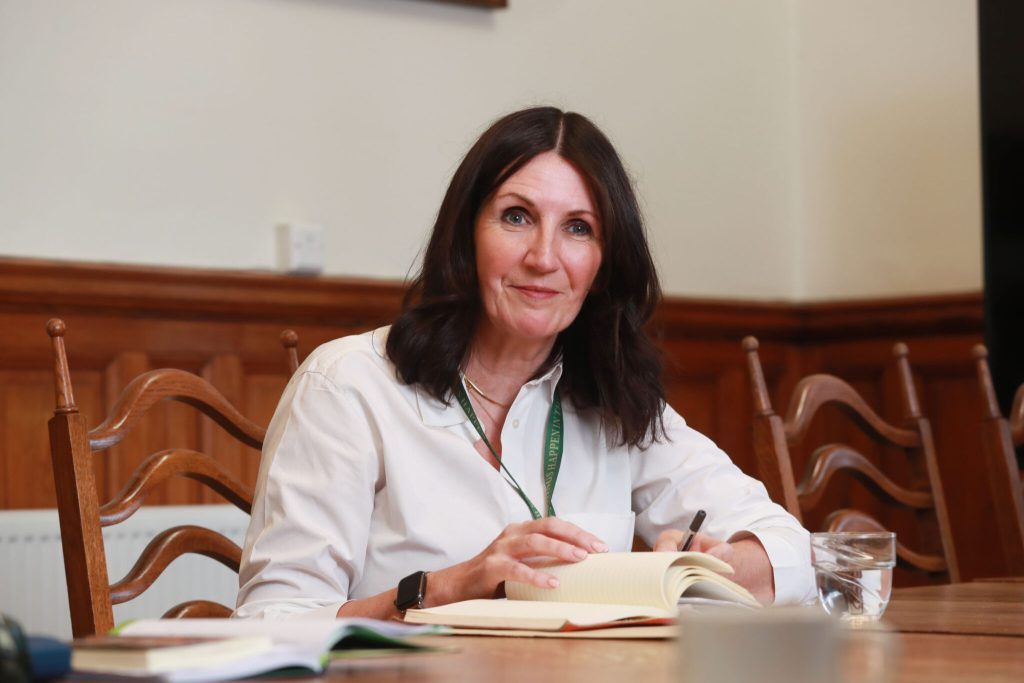
Anne Walker (Image: St Aloysius’ College)
For Jesuit Missions volunteer Anne Walker, the Society of Jesus has always been an inspiration.
From tales of early missionaries venturing out to the far corners of the earth to work with the poor and marginalised, to their commitment to improving our modern world, the Jesuits and their character have had a real impact on her.
“I always think of that Jesuit ethos of going to the margins, rolling up your sleeves and working with those in need,” she tells me in the Cana Lounge Café at the London Jesuit Centre.
“My mum was a great believer in the Jesuits. If there was something that needed doing, she’d say ‘send in the Jesuits’.
“They were founded on this tradition of service; it’s a great reputation and something that’s very attractive.”
Anne has taken her mother’s words, and a commitment to service, with her into her professional life.
An active member of the Jesuit parish of St Aloysius in Glasgow, she is keenly involved with St Aloysius College, supports the local Young Adult Ministries group, and regularly volunteers for Jesuit Missions.
This, she explains, stems from the idea of wanting to “do her bit”.
Click here to read the full interview with Anne.
Santa Marta Conference on the Transition Away from Fossil Fuels: a volunteer’s perspective

Diana, a Sustainability, Innovation and Business Consultant at the Colombian Foreign Ministry, TERN & Skylight Ventures, conducted interviews with key persons in Colombia gathering their thoughts about the transition away from fossil fuels.
The choices we make every day are closely connected to the extraction of minerals and fossil fuels in places suffering social and environmental damage across the world.
For decades, fossil fuels have powered the planet. In Colombia, the region of La Guajira has endured 45 years of continuous coal mining, suffering serious environmental and social consequences at the hands of one of the world’s most powerful mining companies, Glencore.
What is most striking is that despite this exploitation, of the land and of the people, all the coal is taken elsewhere, and local communities receive no benefit from the resources extracted from beneath their feet. That image of inequality, and the abandonment of places like La Guajira, still moves me.
Many of us have assumed that the answer lies in transitioning to alternative energy sources. But it was enormously valuable to learn that every form of extraction carries its own impact, and that energy transitions are temporary solutions rather than long-term answers.
This led me to ask: what paths do we actually have? I find myself thinking that we have no real alternative other than to choose to reduce our appetite for excessive consumption. I am more conscious today than ever that we need to find a balance, to remain in a state of constant reflection.
So that the next time we switch on a light at home, or consider adding another device to our lives, we pause and ask: Where does this energy come from that I have the privilege of using? What minerals are inside my phone?
Becoming aware of how communities in Colombia have suffered and have even faced violence for defending their land against further extraction, puts me in a state of mindful attention. It makes me want to take greater care with that scarce energy, knowing that people thousands of kilometres away are fighting to protect it.
I realise we are facing a problem of enormous scale, one that most of the world has yet to truly see. Even so, as with all great challenges, I see within it a powerful opportunity: to return to our roots as human beings, to reconnect with nature and with one another, rather than with the forces that pull our attention towards consuming ever more.
Click here to read more about the Santa Marta Conference.
If you are interested in volunteering with us, please contact info@jesuitmissions.org.uk